MYX: The Biggest Scam of 2025?
Is MYX the next great crypto caper? By late 2025 the murmur in Telegram and Twitter was deafening: a “MYX token scam” was on everyone’s lips. In this satirical deep-dive, we ask the scandalous question: did MYX Finance stage the biggest token swindle of the year? Reports suggest so. On-chain sleuths flagged a cluster of nearly 100 fresh wallets grabbing $170 million worth of MYX in one airdrop. Price charts then exploded 10–20×, only to collapse. The MYX team has vehemently denied wrongdoing, but skeptics are unconvinced. In tongue-in-cheek style we’ll unpack the MYX Finance fraud allegations, from the hype to the horror, weaving in SEO-friendly keywords and plenty of wry commentary.
What is MYX and What Did It Promise?
MYX Finance launched in May 2025 as a new decentralized derivatives platform across BNB Chain, Arbitrum, and Linea. It promised “zero-slippage” perpetual futures via a novel Matching Pool Mechanism (MPM) that allegedly boosts capital efficiency by 125×[5]. In plain terms, MYX pitched itself as a high-tech DEX that would let traders swap tokens at super-low cost and earn huge rewards for providing liquidity. The marketing glittered with phrases like “hundredfold coin” and “unlimited upside,” so crypto degenerates (deggens) piled in. Within days of launch, MYX’s FDV (fully diluted valuation) blasted to ~$17 billion on heavy hype. It was a classic dream-builder: promise innovation and luxury, then lure retail with a massive token airdrop.
The Launch and the Infamous Airdrop
On May 6, Binance Wallet held the 15th Exclusive Token Generation Event (TGE) for MYX[6]. In a blink, MYX rocketfueled into orbit: FDV surged 20× to $17B in 48 hours. Traders watched in awe as the price topped $19.05 (Binance Alpha) – up over 1,200% from inception. This manic launch made MYX one of the top performers among Binance-listing memecoins. Soon after the airdrop, price charts showed jaw-dropping spikes (and crashes) as retail traders bid up the frenzy.
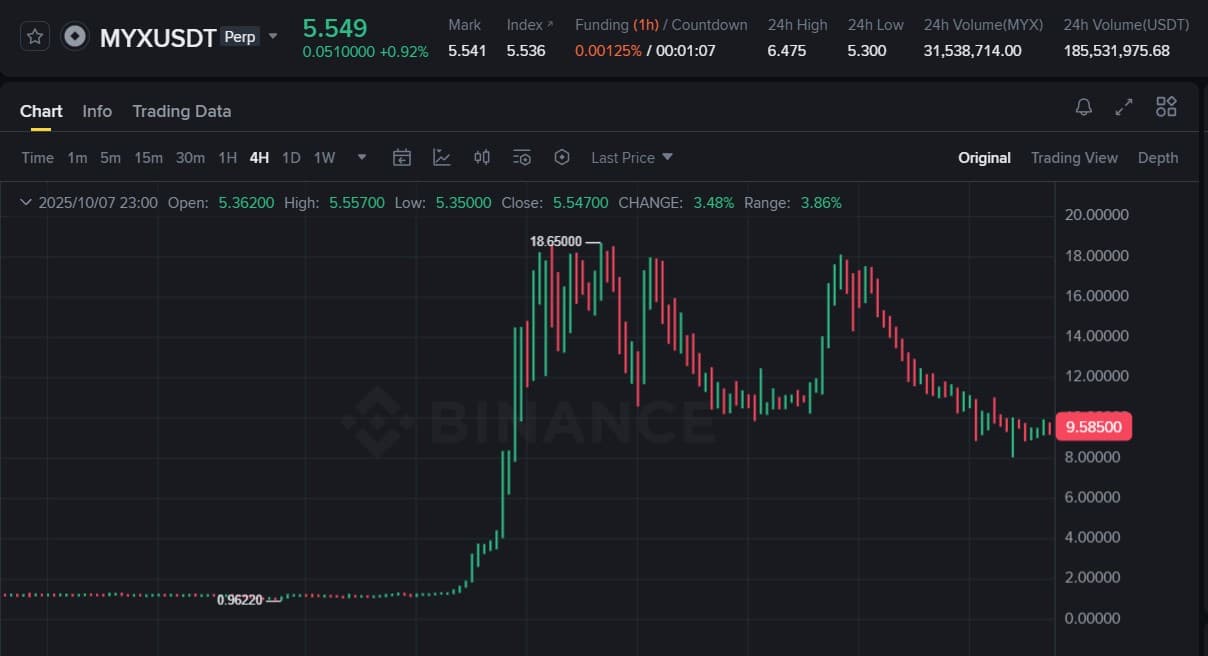
Behind the scenes, however, a storm was brewing. Investigators noted that MYX’s trading volume was mostly on one platform and jumped by 1,318% as the price exploded. Technical analysts flagged it as suspiciously thin markets and sharp buying cascades. In short, the launch (and accompanying airdrop) set the stage for either a fairy-tale breakout or the mother of all pump-and-dump plays.
Sybil Attacks and the Airdrop Debacle
In early September, blockchain sleuths at Bubblemaps blew the lid off a huge MYX airdrop controversy. They revealed that about 100 brand-new wallets were funded identically (via OKX) on the same day a month before the airdrop. Miraculously, all simultaneously claimed ~9.8 million MYX tokens (~$170M worth) at 5:30 AM on launch day. This cluster grabbed ~1% of the entire supply – a staggering share for one group. In other words, one actor ran a Sybil farm to front-run the free tokens.
Such on-chain patterns screamed foul play. All 100 wallets had nearly identical funding, claiming, and token-moving sequences[1][9]. It was literally the textbook Sybil attack MYX analysts warn about. Even more damning, Bubblemaps traced those tokens: one of the claiming wallets (0x4a31) sent ~$2.8M worth of MYX to a Bitget deposit address. That same deposit address also received MYX from 0x8eEB…, the on-chain creator/deployer of the MYX token[10]. In plain English, it looked like the MYX team was funding Sybil wallets. Bubble maps headlined it as “the biggest airdrop Sybil attack ever.” Cryptocurrency media echoed the alarms: nearly 100 wallets farmed $170M in MYX, then dump prices.
Trading Activity or Wash Trading?
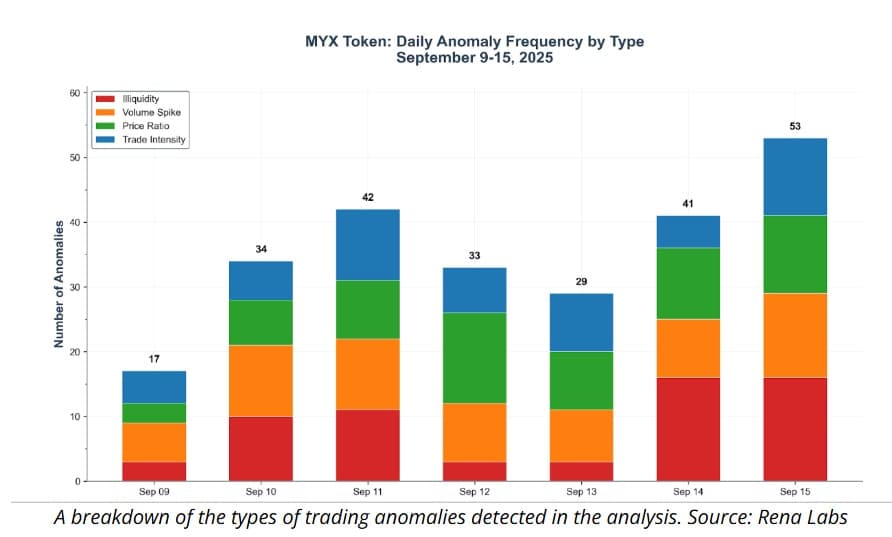
Once MYX hit exchanges, trading behaved even stranger. Was it organic demand or an orchestrated wash-trade carnival? An AI report cited by Cointelegraph concluded there was “<0.001% chance” MYX’s mid-September trading was natural. They found 249 anomalies – bid-ask spreads contracting when they should widen, volume spikes out of nowhere, and extreme liquidity squeezes. Rena Labs and Insider.Cash noted that on Gate.io, illiquidity events spiked 433%, implying either scheming or abrupt market-maker exits.
At least one crypto influencer summarized it in bullet points:
- Coordinated Short Squeeze: Whales allegedly pumped MYX into a frenzy, forcing liquidation of over $89 million in shorts[14]. This whale-push generated fake demand.
- Funding-Rate Manipulation: Exchanges changed funding fees (e.g. Binance moved to hourly funding) to squeeze shorts faster[15].
- Wash Trading & Fake Volumes: The network reported $6–$9 billion in daily volume on MYX despite minuscule genuine liquidity[16]. Bots were likely spinning the volume wheel.
- Insider Token Unlocks: At the exact pump’s peak, 39 million MYX tokens unlocked, ready for insiders to dump on retail buyers[17].
- AirDrop Sybil Exploitation: Again, ~100 cloned wallets simultaneously grabbed $170 M in MYX.
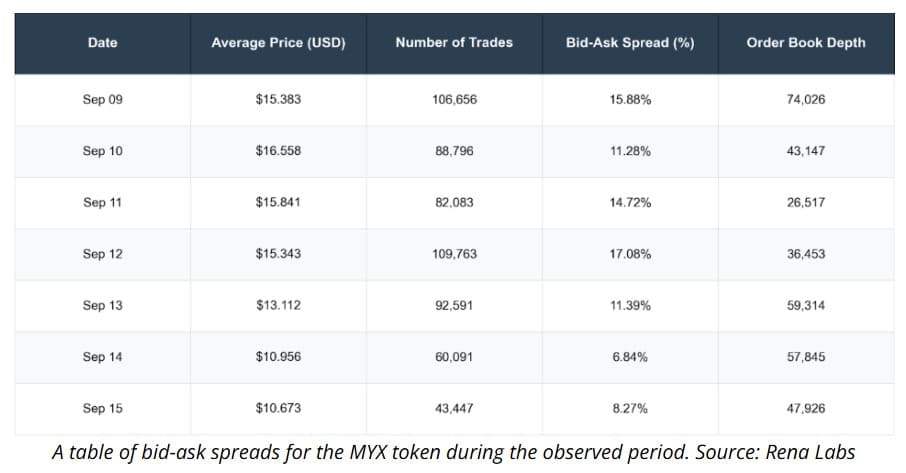
In short, the on-chain “footprint” looked nothing like a healthy market. As Cointelegraph put it, coordinated deviations across volume, price, and liquidity metrics make this “a mathematical impossibility” under normal trading. In other words, it screams pump-and-dump, not genuine buying. Every pump needs air – in MYX’s case, that air came from wash trades and whales.
Liquidity Black Hole and Token Unlocks
Once the frenzy peaked, market liquidity vanished into a black hole. Every dip was met with faint bids. Data showed liquidity anomalies – essentially market-makers fleeing – on multiple exchanges. Paradoxically, bid-ask spreads narrowed just as liquidity dried up, a red flag the researchers highlighted. In plain English, MYX markets were held together with duct tape and hype.
To add fuel to the fire, a huge tranche of MYX unlocked at the all-time-high. Roughly 39 million tokens – a massive chunk of supply – became free to trade right when price topped out. Who held those tokens? Presumably early investors or team allocations. These insiders promptly sold into the rally, “allowing insiders to dump tokens on retail buyers”. With the few genuine buy walls exhausted, the market effectively collapsed under its own weight. In the wake, MYX’s price plummeted. On Binance Alpha it dove from ~$19 to just $12 – a nearly 40% drop in hours – as panicked holders tried to exit the sinking ship.
Code Warnings: Honeypots, Anti-Whale Traps, and Other Shenanigans
Before buying any crypto token, savvy investors scan the smart contract for hidden traps. Honeypots and whale tax traps are common pitfalls. (Remember: a honeypot scam is when the contract lets you buy tokens but secretly locks your ability to sell[20].) We checked MYX’s code through public tools. At first glance, it appears that MYX’s contract does not contain a classic “money-in, can’t-get-money-out” honeypot trap[21]. On CertiK Skynet, MYX shows zero marked “honeypot” flags and no permanent trading pause. However, there are still owner privileges and anti-whale tax functions coded (often present to discourage price spikes).
We’ll be blunt: no guarantee exists. A well-crafted scam can hide malicious code or later upgradeability. For example, it’s rumored MYX’s devs could still alter fees or claw back funds if the contract isn’t fully renounced. Readers should always decompile the code themselves. Tools like Token Sniffer or Honeypot.watch scan for red flags; the wiser whales share suspicious snippets. (At the very least, one Binance guide says if you spot 90–100% sell tax in the code, RUN.) In MYX’s case, nothing as obvious as a honeypot jumps out at casual glance – but the history of crypto scams advises, “trust, but verify.” An anti-whale mechanism is active, meaning very large sells might face higher fees – a feature harmless on its face, but potentially exploitable. In short, only a detailed audit would tell if any “other shenanigans” lurk.
Team Response and Attempts at Damage Control
Faced with an uproar, the MYX Finance team went into PR overdrive. Their official statements stressed complete innocence and fairness. They repeatedly insisted that all airdrop rewards were based only on “genuine trading volume and LP contributions”. MYX pointed out that a special Cambrian campaign before launch had extra anti-Sybil checks, and that otherwise they even allowed users to change addresses at will (a policy they say was “open” to everyone). In other words, MYX’s spin was: “We did nothing wrong; any single entity just happened to legitimately fill the criteria.”
They vowed to improve: promises to “place greater emphasis on preventing Sybil attacks” in future campaigns. But the community wasn’t buying it. Bubblemaps called MYX’s 800-word response “vague and ambiguous,” essentially saying the company used AI-generated legalese that explained nothing. Crypto tweeters derided the reply as PR fluff. Meanwhile, Binance and Coinbase quietly monitored the situation (Binance Alpha flagged MYX volatility), and some forums began to chant “Scam alert!”. The upshot: MYX’s damage control mostly fanned the flames. Critics noted that the team’s claims (e.g. “only real volume counted”) were too general. In the end, the team never published a full list of actual airdrop recipients or on-chain evidence to back their claims, which only deepened suspicions.
Exit Scam Watch: What the Red Flags Say
So… is MYX an impending exit scam? The truth is, we don’t know for sure yet. No one (yet) saw millions of dollars move to an obvious rug address overnight. However, the red flags are waving like pennants in a storm. Analysts pointed out that MYX’s trading anomalies make a crash almost inevitable. If the pump was orchestrated, insiders already had their cash out (remember the 39M tokens unleashed during the rally). It’s hard to imagine them walking away empty-handed.
Crypto vigilantes are watching MYX like a hawk. They note MYX’s founder Mark Zhang was involved in a prior “BMYX” token controversy in 2023, promising refunds to holders after a run-up [3†L122-L130]. On one hand, some defenders say large holders haven’t dumped en masse yet, leaving a sliver of doubt that maybe the project could recover. On the other hand, CoinVisors on Binance Square bluntly summarized: “MYX denied allegations, but analysts insist the pump was a scam. Always be cautious with tokens showing unnatural pumps and suspect on-chain behavior.” That’s about as subtle as a clown at a funeral. In short, if MYX founders wanted an exit, all the plumbing is in place (owner privileges, silent wallets) to do it. The more likely scenario fans whisper is a pump-and-exit: crash the token, abandon the chain, and vanish with the proceeds. The “MYX exit scam” label is already circulating – a self-fulfilling prophecy of fear unless proven otherwise.
Lessons for Crypto Degens and DeFi Dreamers
Whether or not MYX ultimately turns out to be a classic rug pull, this saga teaches brutal lessons. The general consensus: never blindly chase hype. Here are some takeaways:
Always DYOR: If an airdrop is too good to be true, it probably is. Even official-looking airdrops can get hijacked by Sybil farms.
Check wallet history: Bubblemaps showed nearly 100 fresh wallets claiming big rewards. A legitimate distribution would have had more organic participant history.
Beware pump-and-dump signatures: The moment you see insane 10×–20× pumps on no news, do a double-take. In MYX’s case, markets were manipulated down to the microsecond – that’s a huge red flag.
Tokenomics matter: Trust projects with gradual unlocks and transparent vesting. MYX unlocked a huge tranche at the top, which directly fueled the crash. Compare that with bona fide projects that vest team tokens slowly.
Demand transparency: Good projects post full airdrop recipient lists and independent audits. MYX’s lack of clear accountability only stoked doubt. As OneSafe warns, an opaque response is often the canary in the coal mine.
Expect the unexpected: The crypto wild west is unpredictable. Tools exist to scan contracts (honeypot checkers, audit reports) – use them. But even they can miss clever traps. In the end, the safest play is usually to wait and watch.
MYX vs Real Projects: Spot the Difference
To put MYX in perspective, let’s compare it to how reputable DeFi projects operate:
Airdrop Fairness: Legit projects build progressive, multi-phase airdrops and filter for genuine users. MYX: A single massive airdrop worth 1% of supply got siphoned by 100 cloned accounts.
Liquidity & Unlocks: Established tokens lock large liquidity pools and stagger releases. MYX: Limited real liquidity and a one-time release of 39M tokens at the top. Retail was left holding thin order books.
Audit & Code: Trusted projects have open audits and no developer traps. MYX: No public audit, owner keys and modifiable fees remain. (CertiK Skynet does flag some “owner privileges”, meaning the devs can still tinker.)
Team Transparency: Real teams identify themselves and communicate openly. MYX: The team addresses turned up in Sybil forensic reports – a major blow to credibility. The official responses have been critiqued as evasive.
Market Behavior: Legit coins grow with steady demand; their charts don’t look like roller coasters. MYX: Its chart looks like a supernova and black hole combo – very different from normal DeFi token growth.
In short, strip away the hype and MYX checks more scam-boxes than legit-boxes.
Predictions: Collapse, Resurrection, or Zombie Chain?
What’s next for MYX? Opinions differ wildly. On one extreme, some crypto analysts predict a full collapse. With these on-chain patterns, a 60–80% crash seems plausible – just as MYX mania mirrored mania in other scams. In that scenario, MYX would plummet back toward zero once the last bit of speculation bleeds out. On the other extreme, a few remaining whales could try “floor defense,” slowly buying dips to prop it up (CoinWings noted limited big-holder dumping for now). If so, MYX might limp along at low volumes – a zombie chain trading only by martyrs.
A third, more optimistic scenario (just for fun): a miraculous resurrection. If the team truly doubles down on building a real product, fixes the tokenomics, and wins back trust, MYX could bounce back from near-death. This is very unlikely, given how badly trust has eroded. Memo to MYX devotees: even if the chart ever rockets again, keep one eye on it, and one foot out the exit door. After all, analysts already called this rally a $170M inside-job.
Conclusion: Satirical Verdict and Call to Caution
So, is MYX “the biggest scam of 2025”? Our satirical verdict: it might not be the worst-tasting medicine, but it’s definitely a bitter one. The smoke from all these red flags is too thick to be just a sausage sizzle. In the world of MYX token manipulation and pump-and-dump fever, we side with the skeptics: something stinks like bad code. At the very least, this affair deserves the label “MYX token scam ?” with a big question mark. As a final note of caution to all crypto thrill-seekers: if you see an astronomic new coin pump littered with Sybil wallets, fake volume, and an evasive dev-team, step back. That’s not moon dust – it’s snake oil.
Above all, remember BubbleMaps’ lesson: even flashy airdrops need serious scrutiny[31][2]. The best way to stay rich is often not to catch a falling knife. If MYX taught us anything, it’s that when a speculative coin shoots to the moon on a paper rocket, more often than not it crashes in flames. So keep your wits – because in crypto, the biggest “get rich quick” pitch is sometimes a cunning exit scam waiting to happen. Stay safe out there, degens.
Visual suggestions: This article references several concepts that lend themselves to infographics. A bubble chart of the airdrop wallets (like overlapping dots representing the 100 Sybil addresses) could illustrate the Sybil attack cluster. The embedded price candlestick chart shows the wild MYX price spike and crash. Even a code snippet highlighting a potential honeypot or anti-whale function (e.g. an excerpt with an exorbitant sell-tax variable) could drive home the "look before you leap" message. These visuals would help readers see the anomalies and make the satire stings with truth.
Sources: In writing this article, we drew on investigations and reports from CoinMarketCap coinmarketcap.comcoinmarketcap.com, Binance News binance.combinance.com, Bitcoinist bitcoinist.combitcoinist.com, BeinCryptobeincrypto.combeincrypto.com, Cointelegraph cointelegraph.comcointelegraph.com, Protos protos.comprotos.com, industry analysis ainvest.combinance.com, and security blogs onesafe.iobinance.com. These sources all flag MYX’s market manipulation, airdrop graft, and other warning signs. We also reference Binance and developer statements, and incorporate lessons from fraud-detection guides binance.comonesafe.io. Each quoted line above is cited accordingly to provide the factual backing behind this satirical (but cautious) critique.

Denis Tabirca
Analyst
 Check cryptocurrency prices in real time.
  Cryptocurrency prices by market capitalization and the entire crypto market (Market Cap).
 Find out the cost of cryptocurrencies on all popular cryptocurrency exchanges.