ASTER DEX: Scam or Not?
ASTER DEX is a newly launched decentralized exchange (DEX) specializing in perpetual futures trading. Billed as a “next-generation” platform, ASTER was created in late 2024 through a merger of BNB Chain projects Astherus (an on-chain leveraged trading protocol) and APX Finance (a perpetuals DEX infrastructure). Its stated purpose is to offer non-custodial spot and perpetual trading (including U.S. stock contracts) with high leverage (up to 100× or even 1001× in simple mode) across multiple blockchains. The project emphasizes features like hidden orders (to prevent front-running) and the ability to use yield-bearing collateral (e.g. “asBNB” token) to earn passive yield while trading. In short, ASTER markets itself as a hybrid perp-DEX + yield platform with a “Trade & Earn” model.
Platform Overview
ASTER aims to combine advanced trading tools with broad accessibility. Key features and architecture include:
- Perpetual & Spot Trading: ASTER supports perpetual futures contracts as its core product, along with a spot mode. According to the official docs, it offers three trading modes: a Pro (orderbook) mode for professional traders, a 1001x simple mode for one-click high-leverage trades, and a Spot mode for traditional orderbook spot trading. This dual-interface approach is meant to serve both sophisticated and casual users.
- High Leverage: The platform advertises very high leverage: up to 100× in Pro mode and an eye-catching 1001× “Degen” leverage in simple mode. (For comparison, competitor Hyperliquid allows roughly 40× leverage, and Uniswap offers no leverage as it is a spot AMM only.)
- Multi-Chain Support: ASTER is deployed natively on multiple blockchains without relying on bridges. Specifically, it supports Ethereum, BNB Chain, Solana, and Arbitrum. This means users can trade on any of these chains via ASTER’s unified interface. The multi-chain design claims to increase speed and reduce cross-chain risk.
- Order Types and Tools: ASTER offers advanced order types. It has “hidden orders” (which conceal trade size to avoid front-running), trailing stops, grid trading and more. Traders can toggle between the Pro interface (full orderbook, advanced tools) and the simple 1001× interface (one-click trades). According to the docs, hidden orders and grid trading are supported features.
- Fees: ASTER’s trading fees are extremely low. Trusted reports confirm maker fees of 0.01% and taker fees of 0.035% for perpetual trades. This was highlighted when Trust Wallet integrated ASTER: the wallet’s announcement noted those same fees. (By comparison, Hyperliquid’s fees are also very low, and Uniswap’s standard fee is 0.3% per swap in V2/V3 pools.)
- Earn Products: In addition to trading, ASTER continues the legacy of Astherus’s yield products. There is a fully collateralized stablecoin USDF (backed by crypto and futures) and yield-bearing tokens like asBNB (Astherus Staked BNB). Users can stake ASTER collateral to mint these, earning yields (e.g. ~15% APY on asUSDF). The platform integrates these products under “Aster Earn.”
- Security & Smart Contracts: The codebase is large and complex. One audit report page shows that AsterVault (on BNB chain) is ~30,379 lines of code, and the core ASTER contracts span roughly 52,000 lines across five chainscryptoninjas.net. The protocol claims to have been audited: GitBook references show audits by firms like PeckShield and Salus on key components (AsterVault, AsterEarn, asBNB, USDF). However, these firms are not the largest auditors (and some reports are by PeckShield, which is relatively small). There is no widely publicized audit from top auditors (e.g. Certik, ChainSecurity) for the entire platform, so the security review is partial. Given the complexity (multiple chains, new contracts like AsterChain in dev), potential vulnerabilities remain a concern.
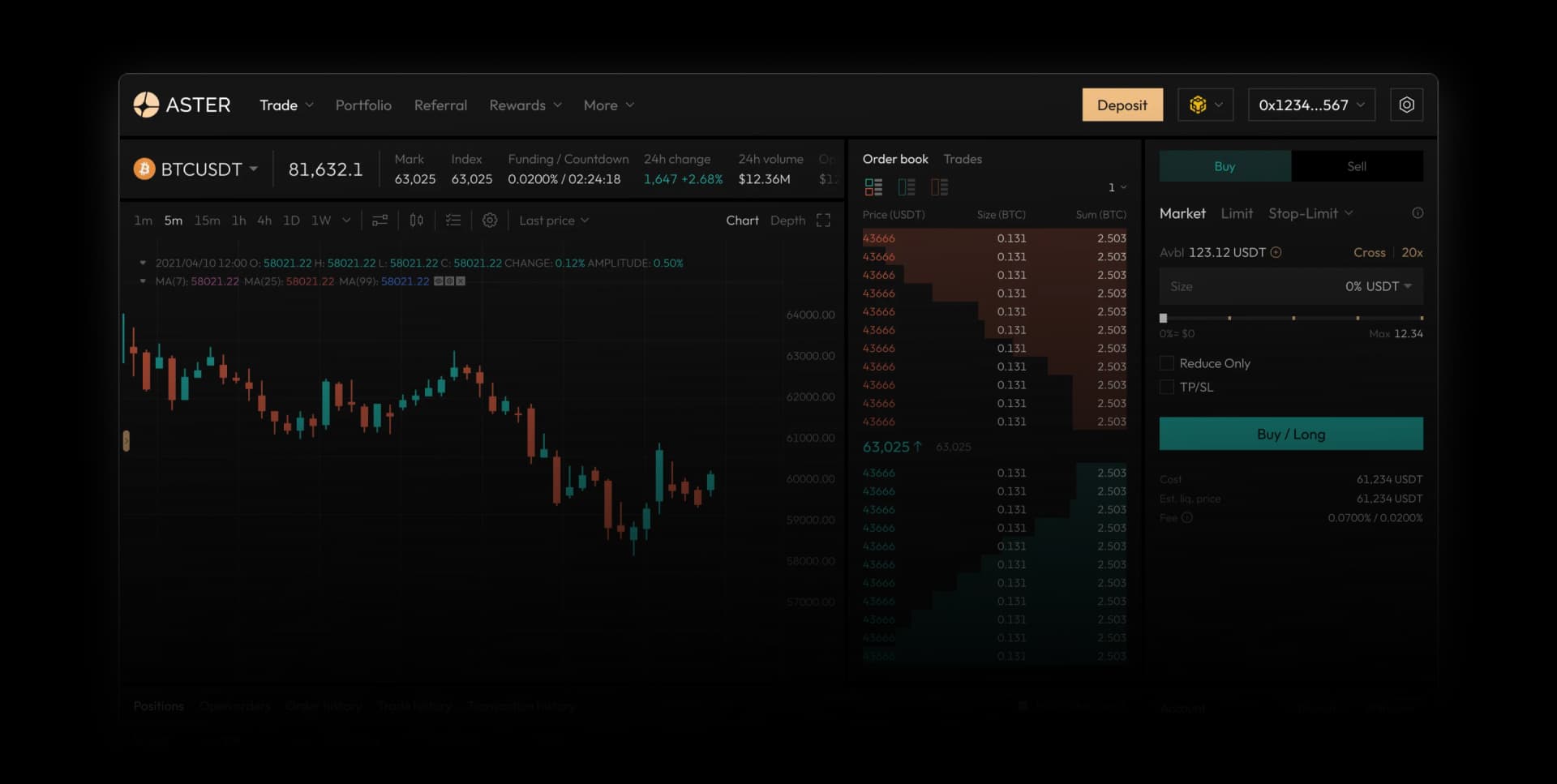
Visually, ASTER’s interface is promoted as streamlined for both newcomers and professionals. According to a platform overview, the UI is “built for clarity and control,” with both simple and pro modes. Early users report that the trading interface is similar to centralized futures DEXs, with integrated perpetual charts and order books. On the downside, because many trades and order details are “hidden,” some critics note that average traders lack transparency into the full orderbook.
Project Leadership and Company
ASTER’s team is notably anonymous. The CEO goes by the pseudonym “Leonard”, with no real name or identity revealed. His public persona appears only via project communications (AMAs, press), not as a verifiable individual. Aside from “Leonard,” only a couple of roles have semi-anonymous names (e.g. a business development lead known as “Ember”). In short, there are no known founders or developers whose backgrounds can be verified in public records. This level of anonymity is a classic red flag in crypto projects.
On the positive side, ASTER has credible institutional backing. It was incubated by Yzi Labs (formerly Binance Labs) in late 2024. Yzi Labs is associated with Binance co-founder Changpeng “CZ” Zhao and co-founder Yi He, which implies a connection to Binance’s resources. Indeed, CZ has openly promoted ASTER on social media, which has drawn massive attention. The marketing hype centers heavily on CZ and early YouTuber endorsements (MrBeast was reported to have bought $114K of ASTER). This backing helps ASTER seem legitimate, but it also raises questions: Is ASTER an independent project or effectively an unofficial Binance spin-off? So far, no formal corporate entity is publicly documented. Some reports (e.g. press articles) mention a Mauritius address (“6 St Denis Street, Port Louis”) as a registered office, but without an official filing document we can’t confirm it. In summary: team transparency is very low. We have no record of a legal company or leadership beyond “Leonard” and no biographies or team profiles to vet.
ASTER Token (ASTER) Deep Dive
The ASTER token is the native governance/utility token of the ASTER ecosystem. Its tokenomics and market history contain several notable points:
- Supply and Distribution: ASTER has a fixed max supply of 8 billion tokens. The initial circulating supply at TGE (token launch) was about 1.66 billion (about 20.8% of the max supply). Distribution was heavily weighted toward community and ecosystem: 53.5% (4.28B) was earmarked for airdrops, 30% (2.4B) for ecosystem incentives, 7% (560M) for treasury, 5% (400M) for team, and 4.5% (360M) for liquidity/listings. The airdrop alone was over half the supply, which is extremely aggressive (most projects do single-digit % airdrops). This means a huge amount of ASTER was unlocked immediately to thousands (or millions) of users, with vesting presumably for teams and treasury. On-chain trackers now show every other wallet holds ASTER, but 53% of tokens were distributed widely at launch.
- Lockup and Emission: The public info suggests many tokens may still be locked up (team/treasury) or releasing over time. The initial supply is only ~20% of total, so up to ~80% could flood the market later. CoinGecko notes an “initial circulating” 1.66B at TGE, implying there will be large future unlockscoingecko.com. This creates significant dilution risk.
- Utility: ASTER is integrated into the platform in various wayscoingecko.com: holders can participate in governance votes (protocol upgrades, fee changes), they receive trading fee discounts on ASTER, and they can stake ASTER to earn revenue share (via buyback programs). The team also intends to use ASTER for funding grants and bootstrapping the ecosystemcoingecko.com. In practice, ASTER has so far been used mainly for speculative trading and staking (earn programs), and less as a governance token since DAO governance hasn’t launched yet.
- Price History & Volatility: The ASTER token’s price action has been wild. It launched mid-September 2025 at around $0.10-$0.12, then exploded by roughly +1500% to $2.1 within days. Some reports say up to a +1700% spike to nearly $2. This initial surge was driven by huge hype: promotions by CZ, airdrop mania, and retail FOMO. However, it was followed by sharp swings. By late September, ASTER retraced about 35% from its highs. On September 25th, a technical glitch (an index error on the XPL/USD perpetual) caused a temporary flash spike and liquidations. ASTER reimbursed traders after the glitch; the token briefly dropped ~14% that day before recovering to ~$1.91.In short, ASTER’s price history is marked by extreme volatility. It surged on big news/endorsements, but also sank on glitches or market shifts. Trading volumes are enormous (CoinCentral reports ASTER daily futures volumes over $100 billion on record days, far outpacing older competitors). But much of this activity appears speculative. As CoinGecko notes: “extreme speculation and volatility” have characterized ASTER’s market, likely driven by short-term hype rather than organic usage.
- Market Position & Sentiment: ASTER debuted as one of the hottest new DeFi tokens. It was listed rapidly on major exchanges (Bybit, MEXC, etc.) and on-chain DEXs (PancakeSwap, Uniswap)coinpedia.org. Its community grows fast (Blockonomi reported 330K new wallets in 24h at peak) and volumes dwarf legacy DEXs. Traders tout its low fees, high leverage and CZ stamp-of-approval. A 40% 24h surge at one point (mentioned in Ainvest news) sparked warnings about liquidity and whales. Despite growth, many analysts remain cautious: ASTER is fighting for market share vs. established perp DEXs like Hyperliquid, and its novelty plus token concentration fuels skepticism.Community sentiment is mixed. On forums and social media, excitement is high among early adopters, but many seasoned traders express wariness. For example, one Reddit user warned ASTER is “just budget Hyperliquid” with “tons of wash trading” and predicted it won’t succeed without CZ’s backing. Others note that Aster’s hidden orders could “hide trades” only benefiting manipulators. Positive posts emphasize CZ’s influence (CZ often tweets his ASTER trades, implying confidence). Critics point to the “insider-heavy” distribution and question whether its hype outweighs fundamentals. In short, the market hype is intense, but informed voices urge caution on ASTER’s long-term viability.
In short, ASTER’s price history is marked by extreme volatility. It surged on big news/endorsements, but also sank on glitches or market shifts. Trading volumes are enormous (CoinCentral reports ASTER daily futures volumes over $100 billion on record dayscoincentral.com, far outpacing older competitors). But much of this activity appears speculative. As CoinGecko notes: “extreme speculation and volatility” have characterized ASTER’s market, likely driven by short-term hype rather than organic usage.
Market Position & Sentiment: ASTER debuted as one of the hottest new DeFi tokens. It was listed rapidly on major exchanges (Bybit, MEXC, etc.) and on-chain DEXs (PancakeSwap, Uniswap). Its community grows fast (Blockonomi reported 330K new wallets in 24h at peak) and volumes dwarf legacy DEXscoincentral.com. Traders tout its low fees, high leverage and CZ stamp-of-approval. A 40% 24h surge at one point (mentioned in Ainvest news) sparked warnings about liquidity and whales. Despite growth, many analysts remain cautious: ASTER is fighting for market share vs. established perp DEXs like Hyperliquid, and its novelty plus token concentration fuels skepticism.
Community sentiment is mixed. On forums and social media, excitement is high among early adopters, but many seasoned traders express wariness. For example, one Reddit user warned ASTER is “just budget Hyperliquid” with “tons of wash trading” and predicted it won’t succeed without CZ’s backingreddit.com. Others note that Aster’s hidden orders could “hide trades” only benefiting manipulators. Positive posts emphasize CZ’s influence (CZ often tweets his ASTER trades, implying confidence). Critics point to the “insider-heavy” distribution and question whether its hype outweighs fundamentals. In short, the market hype is intense, but informed voices urge caution on ASTER’s long-term viability.
Trust Wallet Integration & TWT Connections
In late September 2025, Trust Wallet – a popular non-custodial wallet owned by Binance – officially integrated ASTER’s perpetual trading. Trust Wallet announced that users could trade ASTER’s perpetual contracts (100+ markets, up to 100× leverage) directly in the mobile app. To promote this integration, Trust Wallet ran a 50,000 TWT token giveaway: any user who swapped supported tokens (including ASTER) in the wallet would be entered to win. This was an official Trust Wallet campaign (announced on Twitter and covered by crypto media). In practice, this means ASTER is now accessible in Trust Wallet’s UI, and swapping ASTER tokens in the wallet is supported with zero fees (via Rango/Swft integration).
Aside from that promotion, there is no deeper “technical” connection between ASTER and TWT. ASTER did not change its token model to incorporate TWT, nor has Trust Wallet given ASTER any special functionality of its TWT ecosystem beyond the giveaway. The TWT involvement is purely marketing: it’s a reward incentive to use ASTER within Trust Wallet. Trust Wallet’s own content makes no claims that ASTER is a “feature” of TWT; rather ASTER is one of many tokens included in the giveaway swap pool. In summary: Trust Wallet has officially endorsed ASTER’s perpetual markets, but only as an integrated asset to trade, not as a native protocol. No regular technical support (like code contribution) has been announced; the partnership is a typical DEX listing/integration with a promotional campaign.
Community Feedback and Controversies
Community discussions on Reddit, Telegram, YouTube, etc. reflect a mix of enthusiasm and skepticism:
- Praise: Many users love the features. They cite ASTER’s low fees, hidden orders, and cross-chain perp access. Some experienced traders are impressed that a self-custody app like Trust Wallet now offers 100× leveraged perps via ASTER. Community channels highlight the record trading volumes, fast execution, and “innovative” aspects (like yield collateral). In viral posts, influencers note ASTER’s “institutional-grade” backing (CZ) and the convenience of being able to trade stocks and crypto side-by-side.
- Warnings: Numerous users warn others to “DYOR.” A common refrain is “Don’t believe everything CZ says”, referencing past cases (e.g. CZ promoted Mubarak token which later flopped). Critics highlight red flags: the anonymous team, enormous token concentration, and aggressive marketing. Many note that ASTER’s approach resembles Hyperliquid but on multiple chains, and question if it has the liquidity to compete. Some call ASTER a “rug waiting to happen” because, as one analyst put it, 96% of the supply sits in 6 wallets (a figure echoed by on-chain researchers).
- Glitches & Responses: When the recent XPL price glitch occurred, ASTER’s team earned some praise for rapid remediation: they halted trading, fixed the index issue, and fully reimbursed affected users in stablecoin. This transparency (posting audit logs of reimbursements) helped maintain trust among traders. Such responsiveness (compensating traders for a software error) is viewed positively in contrast to less scrupulous DEXs.
- Scam Allegations: Some social media posts and sites raise outright “scam” or “rug pull” alarms about ASTER. However, these are largely speculative. Security blogs have identified a proliferation of fake ASTER airdrop websites (phishing scams pretending to be the project). These are not the real ASTER platform but bogus sites designed to drain wallets. The existence of these scams indicates that fraudsters are trying to capitalize on ASTER’s hype. It also means newcomers may be vulnerable to phishing if they chase an “aster airdrop.” Reputable sources emphasize: the genuine ASTER DEX does not run random airdrops, and links should be checked carefully.
In summary, the community view is: Exercise extreme caution. Many experienced DeFi users are enthusiastic but also very aware of the risks. Newcomers should be especially wary of unverified social media advice and fake airdrops.
Red Flags and Concerns
Even setting aside the question of outright “scam,” ASTER exhibits several potential red flags that invite scrutiny:
- Anonymous Leadership: As noted, no known identities behind ASTER's management. This lack of transparency means if anything goes wrong (exit scam, fraud, rug pull), there is no accountable figure to pursue. Anonymous leadership is often cited as a classic warning sign in crypto projects.
- Token Ownership Concentration: On-chain analysis shows a staggering 93–96% of ASTER’s supply is held by just a few wallets. Coinpedia quoted a bot saying “96% supply in 6 wallets…that’s not a listing — it’s a rug waiting to happen”coinpedia.org. This means a small group (likely project insiders and early investors) controls almost all tokens. Those wallets were inflated (Astherus/APX treasury and early backers). If even a fraction of those tokens get sold, it could crash the price. For retail investors, this is a huge centralization risk: the market is riding on the assumption that these whales will hold their bags.
- Aggressive Marketing & Hype: ASTER’s launch has been accompanied by large-scale marketing and hype tactics. The 53.5% airdrop allocationcoingecko.com, Trust Wallet and SafePal partnerships, CZ tweet endorsements, and influencer pushes (including a famous YouTuber) all scream “promotion.” This isn’t a red flag by itself, but combined with the others it suggests a focus on pumping adoption and price quickly. As some Reddit users note, the hype can collapse if the promotional support wanes. Pump-and-dump schemes often feature heavy initial hype.
- Hidden Orders (Opaque Transactions): While hidden orders are marketed as a feature for trader privacy, skeptics point out they effectively hide trading volume from the public orderbook. One user commented that hiding trades is “only good for manipulators with huge funds”. In practice, this means retail traders can’t see if a big order is lurking, which may undermine trust or price discovery. It’s an innovative tool, but also one that could be misused.
- Tokenomics & Emission: The token release schedule is front-loaded. Over 80% of ASTER tokens were not circulating initially, slated for future unlocks (ecosystem, team, treasury)coingecko.com. This creates the risk of massive sell pressure when those unlocks occur. In fact, early investors already enjoyed ~18× returns by swapping APX to ASTER at launchcoinpedia.org, leaving later buyers with the risk. The supply inflation and massive airdrops raise concerns of dilution and dumps later on.
- Centralization Dependencies: As a protocol, ASTER’s stablecoin (USDF) and staking mechanisms rely heavily on Binance ecosystem (for example, staked BNB via Binance)coingecko.com. If something goes wrong with Binance or BNB Chain (wallet issues, regulations), ASTER could face systemic problems. Users pointed out that any troubles at Binance would ripple through ASTER’s platform.
- New Protocol Risks: ASTER is brand-new, and it’s ambitious (even planning an “Aster Chain” Layer-1). Bugs and technical glitches are likely in early stages. The recent XPL glitch was significant evidence: an improperly configured index caused wild prices. Although ASTER handled it admirably, it shows the platform isn’t battle-tested. Furthermore, any future exploits in the vaults or oracles could be catastrophic due to leverage. PeckShield did audit parts of it, but the combined system’s security remains unproven.
In summary, while ASTER is not an obvious “rug pull” (the team has not absconded with funds, and the product is live), it has many risk factors typical of speculative crypto projects. Investors should view it as high-risk. The combination of anonymous leadership, whale-controlled supply, and aggressive hype means only very cautious, well-informed users should consider engaging—and even then only with tiny positions.
This table illustrates that ASTER’s offering is most similar to Hyperliquid in its perpetual-trading ambitions, but ASTER’s multi-chain scope and hidden-order twist set it apart. In contrast, Uniswap represents the legacy spot DEX model. Importantly, transparency and trust differ drastically: Uniswap is mature and open, Hyperliquid’s team (though infamous) is known, whereas ASTER’s team is anonymous. These differences align with risk profiles: ASTER appears far riskier than a well-established protocol like Uniswap or even Hyperliquid.
Conclusion: Scam or High-Risk?
Is ASTER a scam? There is no definitive evidence that ASTER is an outright scam. It is an active, functioning protocol that delivers on its core promise (perpetual trading) and has compensated users for a major glitch. Renowned crypto outlets and analysts (Coinpedia, CoinGecko) currently classify ASTER as a highly risky token, not an immediate rug pull. ASTER has genuine technology (multi-chain orderbooks, yield engines) and strong backers (Binance Labs), which support its legitimacy. On the other hand, the red flags are significant: anonymous leadership, whale-dominated token supply, aggressive hype, and unproven tech. These factors mean ASTER behaves more like a classic “blue-sky” crypto gamble than an established project.
Who should consider ASTER? Only very experienced, high-risk crypto traders might dabble in ASTER. Those who understand perpetual futures trading, have dealt with hyper-leveraged DEXs before, and can stomach sudden price swings might explore ASTER (in tiny positions). The features (hidden orders, high leverage, yield-on-collateral) are best suited to speculators and yield farmers seeking cutting-edge DeFi tools. Even they should assume most funds will be lost, trading very conservatively.
Who should avoid it? Average users and crypto newcomers should definitely steer clear. If you need a secure, predictable platform for trading or yield, ASTER is far from it. Its combination of unknown team + mega-hype + huge centralization suggests that unless you can accept a potential total loss, you’re better off trading on reputable venues (or at least on more transparent DEXs like Uniswap or well-known derivative platforms).
In summary, ASTER is not clearly a scam, but it is extremely high-risk. It may succeed if its innovations truly find a user base and if the big token holders remain patient. But given all the warning signs – many voiced by the community itself – caution is paramount. Always do your own research. If you decide to interact with ASTER, only use capital you can afford to lose.
Comparison: ASTER vs. Hyperliquid vs. Uniswap
| Feature/Aspect | ASTER DEX | Hyperliquid (HYPE) | Uniswap (UNI) |
|---|---|---|---|
| Trading Scope | Decentralized exchange for perpetual futures and spot trading (crypto & stock contracts) | A Layer-1 trading blockchain + DEX focused on perpetual futures (with some spot) | Decentralized AMM DEX for spot token swaps only (no perps) |
| Networks (Chains) | Multi-chain: native on Ethereum, BNB Chain, Solana, Arbitrum (no bridges) | Runs on its own Hyperliquid chain (HyperEVM) with bridges to others. | Primarily Ethereum mainnet (Uniswap v3) plus deployments on Layer-2s (Arbitrum, Optimism, etc.). |
| Leverage | Up to 100× in Pro mode (and “1001×” one-click mode) | High leverage (in practice up to ~40× as per reports) on perp trades. | No leverage. Only spot trading via liquidity pools. |
| Order Model | Hybrid orderbook-based DEX. Pro mode uses order books (with hidden orders; Simple mode uses on-chain execution. | True on-chain order book DEX on a fast L1 (supports sub-second settlement). | AMM (Automated Market Maker). Trades against liquidity pools; no order book |
| Fees | Very low: maker 0.01%, taker 0.035% | Competitive; tiered by volume (maker/taker as low as ~0.01%/0.035% for heavy traders in practice). | Generally ~0.3% per trade (for major pools), distributed to LPs. (Users can choose different fee tiers in v3 pools.) |
| Token/Utility | ASTER token (8B supply) for governance, fee discounts, staking yield | HYPE token used for governance, staking, and fee discounts | UNI token for governance only; liquidity provision is rewarded in fees but no on-chain yield. |
| Team Transparency | Anonymous “Leonard” CEO and team; no known individuals or company details. | Founded by Alameda/FTX team (e.g. Sam Bankman-Fried); key players known in crypto community. | Founders public (Hayden Adams, later governance by UNI holders); well-known open-source history. |
| Token Distribution | Highly concentrated: ~93–96% in a few wallets (early holders, treasury). | 70% of HYPE was user-focused (rewards/buybacks); wider distribution to community. | Initial UNI airdrop (15%), team funds locked; overall supply distribution is public and less centralized. |
| Security/Audits | Has some audits on components (PeckShield, Salus), but no unified audit of entire protocol. | Smart contracts audited; entire chain+DEX is designed from scratch (underlying code by FTX team). | Extensive audits of contracts, battle-tested; leverages Ethereum’s security. |
| Centralization/Risk | High risk: token and decision-making centralized among insiders; reliance on Binance infrastructure. | Medium risk: single blockchain with known validators; some central coordination (though code is open). | Low-ish risk: fully decentralized on Ethereum; governed by decentralized treasury (Uniswap DAO). |
| Unique Features | Hidden orders for privacy; yield-on-collateral (asBNB/USDF); 1001× simple mode; multi-chain perps. | Sub-second on-chain settlement; HyperBFT consensus; dual-block architecture; fully on-chain order book. | AMM pools with concentrated liquidity (v3); huge aggregate liquidity; very user-friendly for spot swaps. |

Denis Tabirca
Analyst
 Kiểm tra giá tiền điện tử theo thời gian thực.
 Giá tiền điện tử theo vốn hóa thị trường và toàn bộ thị trường tiền điện tử (Market Cap).
 Tìm hiểu giá tiền điện tử trên tất cả các sàn giao dịch tiền điện tử phổ biến.